Brexit Delivered
LatestEU–UK summit, Friday 20 November: what Britain could sign up toAll news

Home / The reset

The reset

Andy Burnham's EU reset: what it costs

The reset began at Sir Keir Starmer's first EU–UK summit in May 2025. Andy Burnham, Prime Minister since July 2026, takes it further at the second summit in Brussels on 20 November 2026. Here is what it is set to cost, what is agreed, what is still being negotiated, and what voters think.

Illustration of a balance scale with coins on one side and a sapling on the other

The reset bill

Payments for Erasmus+ begin on 1 January 2027. Choose a figure to see what the reset would cost every week, every day and every second.

The reset bill starts in

53 days

Per week
£338m
Per day
£48.2m
Per second
£558
While you read this page
£0

The £17.6bn and £20.5bn figures are estimates by Catherine McBride for the Great British Business Council. They cover taxpayers, businesses and universities, and leave out a further £12bn of one-off compliance costs for business. No official total has been published. £17.6bn a year is about £338 million a week.

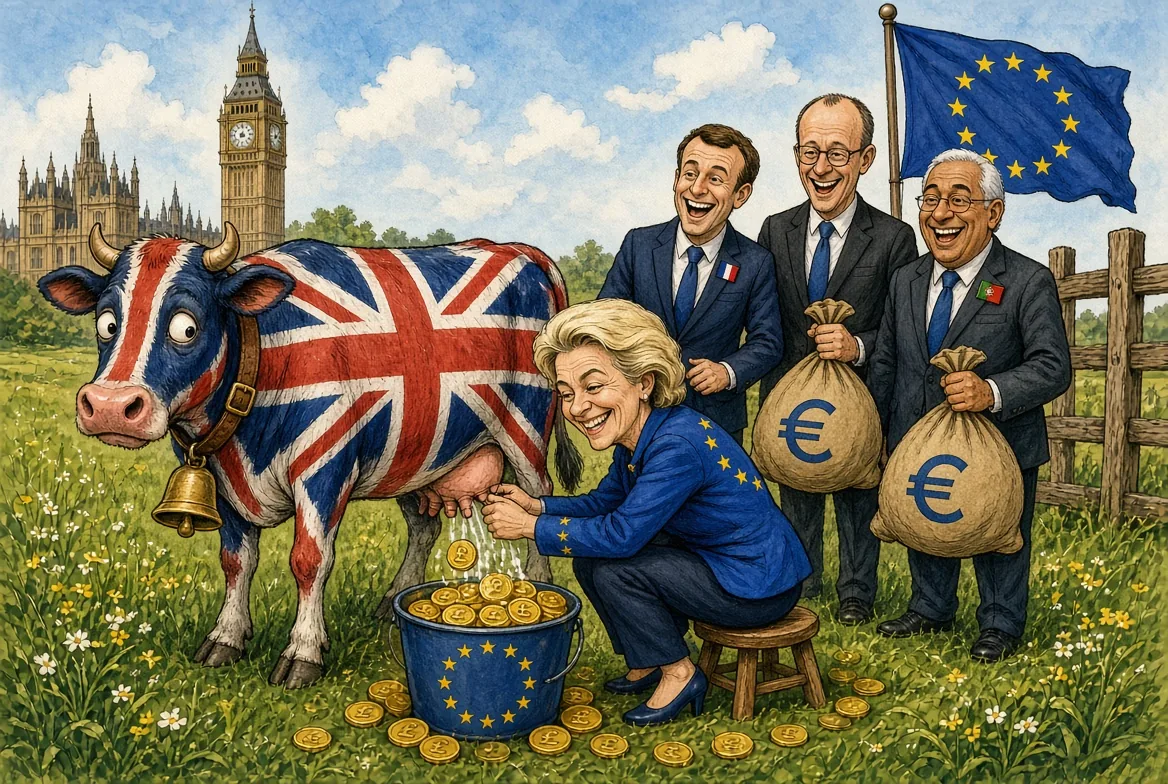
Cartoon: a cow painted in the Union Flag is milked for gold pound coins into a bucket bearing the EU stars by a caricature of Ursula von der Leyen, while caricatures of Emmanuel Macron, Friedrich Merz and António Costa laugh and hold sacks marked with the euro sign. Westminster stands in the background.
Cartoon: who benefits from the reset? Ursula von der Leyen, President of the European Commission, with Emmanuel Macron, Friedrich Merz and António Costa.

780

pieces of EU law a year

House of Lords report, 13 November 2026

A new piece of EU law every 12 hours

The House of Lords European Affairs Committee says dynamic alignment "will fundamentally alter the post-Brexit relationship" with the EU. On the evidence it heard, the food and farming deal alone "might generate at least 780 pieces of in-scope EU law a year": more than two a day. Most would be technical rules made by the European Commission, not laws debated by anyone Britain elects.

The committee also found that the gain from joining the EU's electricity market "could be small or even negative", and that cheaper wholesale power "might not be passed through to consumers' bills". It asked the government to publish what Britain will pay, including towards EU regional funds, before Parliament votes, and noted that the government declined to send a minister to give evidence before the summit.

The committee's chair, Lord Stirrup, warned that the rules "can affect everyday matters, from food standards and consumer prices", and that the changes must not "pass without proper oversight".

House of Lords European Affairs Committee, Dynamic alignment: a fundamental change, HL Paper 88, 13 November 2026; Lord Stirrup, quoted in The Telegraph, 13 November 2026. The 780 figure is the committee's estimate from 65 pieces of EU food law in one month, February 2026.
The Prime Minister's case

Up to 0.4% of GDP. Is it worth the price?

Andy Burnham says the deals on food, carbon trading and youth mobility "could add up to 0.4% to GDP", a figure the Treasury has raised from 0.3%. Here is that gain set beside the estimated cost.

Extra GDP, Treasury estimate0.4% of the 2025 economy, once fully in place£12.1bn a year
Extra tax from that gainAt 37% of GDP, the share taken in tax£4.5bn a year
Estimated cost in 2027Great British Business Council£17.6bn a year
Estimated cost by the 2030sGreat British Business Council£20.5bn a year

The cost is bigger than the gain

Even taken at face value, the extra output the Treasury expects is smaller than the yearly cost estimated by the Great British Business Council. Only about £4.5bn of it would come back to the Treasury in tax.

The bill comes first

Payments for Erasmus+ start in January 2027. The gain builds up slowly: the government's earlier 0.3% estimate was not expected to be reached in full until 2040, and no date has been given for the new figure.

The price is not only money

In return, Britain would follow EU food, farming and energy rules as they change, with no vote on them and the EU's court having the final say on EU law.

The government's own figures: the food deal adds up to £5.1bn (0.14%) and the carbon trading deal £3.8bn (0.1%) to GDP by 2040. The House of Lords committee notes that neither estimate counts the compliance costs falling on firms that do not trade with the EU. £12.1bn is 0.4% of UK GDP in 2025 (£3,034bn, ONS). The 37% tax share is the OBR's forecast. The cost figures are estimates by Catherine McBride for the Great British Business Council; no official total has been published. The Treasury's estimate has not been published in full.

Item by item

What the reset includes

Some of this is agreed. Most is still being negotiated, and the figures for those parts are estimates or leaked drafts.

Agreed

£570m

Erasmus+ for 2027–28

Agreed in December 2025 under Sir Keir Starmer and continued by Andy Burnham's government. The government says the price includes a 30% discount. What Britain pays from 2028 is still to be negotiated. A leaked draft of the summit declaration reportedly sets a fee of £810 million a year from 2028.

UK Government, 17 December 2025; Briefings for Britain, 8 November 2026

In talks

Up to 3 years

A youth experience scheme

Young Europeans could come to live, work and study in Britain. The leaked draft reportedly allows stays of up to three years with no cap on numbers, and EU students paying home-fee rates. The Great British Business Council estimates £2.7 billion a year in lost university fee income.

Briefings for Britain, 8 November 2026; Great British Business Council, 2026

In talks

EU rules

Food and farming rules

Britain would follow EU food and farming rules as they change, at least 780 pieces of EU law a year according to the House of Lords, with the EU's court having the final say on EU law and no UK vote on the rules. The Great British Business Council estimates new packaging rules alone at £2 billion to £3 billion up front, then £400 million to £700 million a year by 2030.

UK–EU Common Understanding, 19 May 2025; Great British Business Council, 2026

In talks

Permanent

A standing payment to EU regional funds

In March 2026 EU ministers authorised talks on a permanent mechanism for a UK contribution to reducing differences between EU regions, tied to access to the EU's electricity market. No figure has been agreed. Facts4EU estimates about £5.5 billion a year.

Council of the EU, 30 March 2026; Facts4EU, 29 October 2026

In talks

No vote

Energy rules without a vote

Britain's energy regulator would sit in the EU's energy agency without a vote, and UK carbon trading would be linked to the EU's. UK rules on electricity, renewables and state aid would follow EU law as it changes.

UK–EU exploratory discussions on electricity, 22 December 2025

Agreed

2038

EU boats in UK waters until 2038

The May 2025 deal gave EU fleets full access to UK waters for a further 12 years, with no change in quota shares.

European Commission; Full Fact

Gene editing is also at stake: the government says the treatment of gene-edited crops is still being negotiated as part of the food and farming agreement. The reset and democracy · What full membership would cost

Was there another way?

Why not mutual recognition, like New Zealand?

New Zealand sells meat and dairy to the EU without copying EU law. Its veterinary agreement with the EU, in place since the late 1990s, rests on equivalence: each side keeps its own rules, and the EU accepts New Zealand's standards as giving the same protection. The reset takes the opposite route.

Mutual recognition (New Zealand)Dynamic alignment (the reset)
Who writes the rulesEach side writes its ownBritain follows EU rules as they change, at least 780 pieces of EU law a year
Final sayNo role for the EU's courtThe EU's court has the final say on EU law
Border checksMost physical checks removed; 1–10% of most meat and dairy still checked, with paperworkMost checks and paperwork removed
Freedom to innovateKept, for example on gene-edited cropsGene editing is still being negotiated
Can be undone by a future ParliamentYesThe EU has reportedly sought compensation if Britain withdraws

Britain asked, and was refused

In 2020 the UK proposed a food and farming deal based on recognising each other's standards as equivalent. The EU rejected it, and in 2021 said only a "structural shift" by the UK, meaning alignment, could cut the checks.

The EU's argument

The EU insists on alignment for close neighbours, and says Britain's food trade is far larger than New Zealand's: about 10% of its agri-food imports against 1%. One academic told the Lords: "Mutual recognition is not on offer to us."

So why not push again?

Britain left with food rules identical to the EU's, so equivalence should be easier to prove than for any other country. Some checks and paperwork would remain, but Britain would keep its own rules, its own trade policy and its Parliament's final say. Dynamic alignment is almost unique: only about 2% of trade agreements notified to the WTO include it, all of them the EU's. The National Farmers' Union said it would have preferred an agreement based on mutual equivalence. As one witness told the Lords: "If you don't ask, you don't get".

UK in a Changing Europe, Veterinary agreements explainer (2024, updated 2025); RTÉ, 3 May 2021; House of Lords European Affairs Committee, HL Paper 88, 13 November 2026, paragraphs 26 to 31 and 104.

In his own words

From a reset to "all the way"

At the Labour conference on 29 September 2026, Andy Burnham said all options were open, from staying as we are to going "all the way" back into the EU, including a customs union and the single market. He said he would set out the options at a summit with EU leaders.

Labour's 2024 manifesto said Britain would stay outside the single market, the customs union and free movement. The second EU–UK summit takes place in Brussels on Friday 20 November 2026.

The Irish Times, 29 September 2026; Euronews, 30 September 2026; Council of the EU, 12 October 2026

The man who wrote the red lines now wants them gone. Chris Ward, Labour MP for Brighton Kemptown and Peacehaven and co-author of the 2024 manifesto's EU red lines, writes in The Guardian that they were "designed precisely to close down the debate and to narrow the target". He says they "no longer speak to the world as it is in 2026" and deserve a "dignified retirement".

In other words, the promise of no single market, no customs union and no free movement was an election tactic. The Prime Minister told ITV he is "not proposing any changes in this Parliament". If the red lines are to go, voters should be asked first.

The Guardian, as reported by the Daily Express, 10 November 2026

Two former Remain Prime Ministers urge caution

"Those are a set of problems that have nothing to do with Brexit."

David Cameron, who led the 2016 Remain campaign, on Britain's economic problems, which he listed as overspending, over-borrowing, over-taxing, over-regulation and spending on working-age welfare. He warned that reopening membership would be a "very long and painful argument", and that "flirting with rejoining" risks a worse partnership deal. Interview with Mishal Husain, Bloomberg, reported 11 to 12 November 2026

Not the EU as it stands

Tony Blair says Britain should not try to rejoin the EU in its current form. He argues the EU has become less competitive since Britain left and is holding back new technology such as artificial intelligence. He wants Britain to strengthen its own economy first, and to work towards rejoining only a reformed EU. His institute's September paper says free movement and a budget contribution could be the price of entry. Tony Blair's remarks of May 2026, as summarised by John Rentoul in The Independent, 12 November 2026; Tony Blair Institute paper, 24 September 2026, as reported by Brussels Signal

What voters say

Burnham's own voters want Britain to decide

A new poll of the Prime Minister's own constituency, Makerfield, asked who should decide policy on ten issues: Britain alone, Britain working voluntarily with other countries, or international institutions whose decisions Britain must follow.

Makerfield: "Britain should decide alone"

State aid for regional development80%
Setting VAT rates78%
Food standards74%
Animal welfare69%
Approving medicines for the NHS67%

Between 2% and 12% said Britain should be required to follow decisions made by international institutions.

Survation for Britain Unbound, published 9 November 2026, as reported by The Telegraph, About Manchester and the Daily Sceptic. Sample size and fieldwork dates were not given in the published reports. Makerfield voted Leave by about 65% to 35% in 2016.

Nationally: support falls when the terms are spelled out

Support rejoining in principle55%
Support rejoining without the old opt-outs35%
Oppose rejoining without the old opt-outs43%

YouGov, 2,114 adults in Great Britain, 2 to 3 June 2026

Headline polls show more people now think leaving was a mistake. But The Spectator's political editor, Tim Shipman, reports that most pollsters see support for rejoining as "very soft indeed", and expect it to fall sharply once voters learn what membership would involve. The YouGov figures above show exactly that.

Sources

Know someone who thinks Brexit failed?

Send them the facts. Every figure on this page links to its source.